
Glossy vs. Matte Film Faced Plywood: Key Differences
Published on — Blog
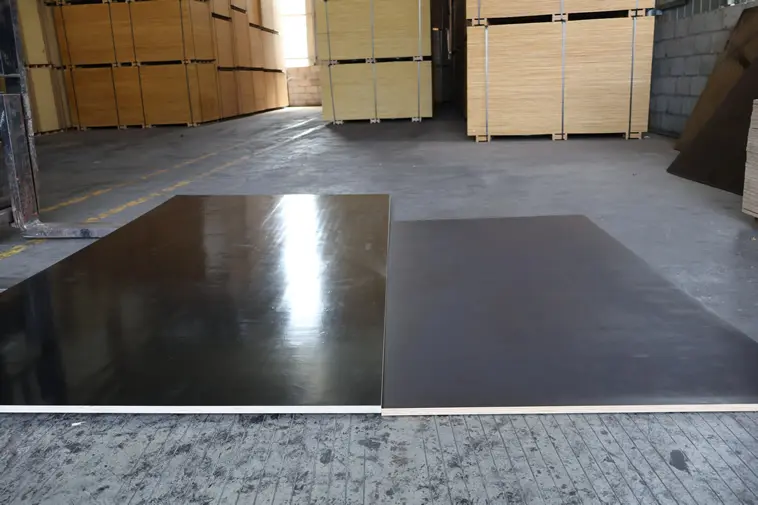
When buyers contact us for film faced plywood, one of the questions we often receive is:
“What is the difference between glossy and matte film faced plywood?”
Both are widely used for concrete formwork, but the difference is not only in appearance.
From a manufacturer’s perspective, glossy and matte film faced plywood can also differ in production process, surface preparation, cost, and suitable applications.
For buyers, understanding these differences makes it easier to choose the right panel for the project instead of comparing products only by price.
1. What Is Glossy Film Faced Plywood?
Glossy film faced plywood has a smooth, reflective film surface and is commonly used for concrete formwork and general construction projects.
Depending on the required specification and quality level, glossy film faced plywood can be produced using either a one-stage or two-stage production process.
Typical characteristics include:
▪ Smooth and glossy surface
▪ Good formwork release
▪ Clean concrete surface appearance
▪ Suitable for general construction formwork
▪ Widely accepted in many export markets
For buyers who need standard formwork plywood in larger quantities, glossy film faced plywood is often a practical choice.
However, not all glossy panels are made to exactly the same specification. Core structure, glue, film quality, pressing process, and thickness control should also be considered when comparing products.
2. What Is Matte Film Faced Plywood?
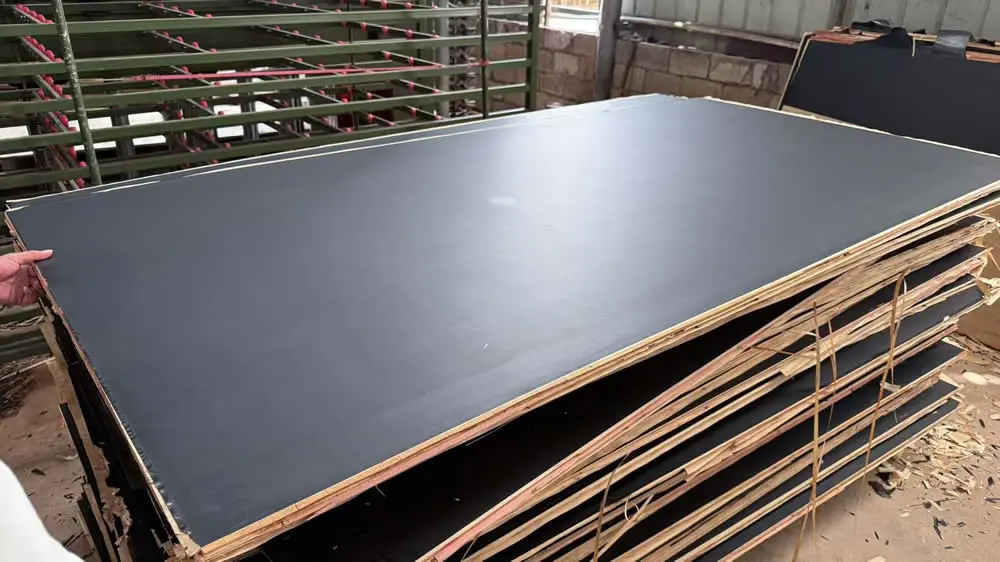
Matte film faced plywood has a lower-reflection surface and a more uniform matte appearance.
The main difference is not simply the film color or visual effect.
At our factory, matte film faced plywood requires a two-stage production process with additional sanding to achieve the required flatness and uniform matte surface.
Compared with a standard glossy panel, more attention is required during surface preparation before the final film pressing.
Typical characteristics include:
▪ Low-reflection matte surface
▪ Flat and uniform surface finish
▪ Less noticeable fingerprints and minor surface marks
▪ Suitable for general formwork applications
▪ Higher surface preparation requirements
Some importers and distributors choose matte film faced plywood because it matches the preferences of their local construction market, while others select it for specific project requirements.
3. Why Is Matte Film Faced Plywood More Expensive?
This is a question we often receive when buyers compare glossy and matte plywood quotations.
The main reason is the production process.
Glossy film faced plywood can be produced using either a one-stage or two-stage process, depending on the product specification.
For matte film faced plywood, however, two-stage production and additional sanding are required to achieve a flat and consistent matte surface.
This means matte production involves:
▪ Two-stage production
▪ Additional sanding
▪ More surface preparation
▪ Higher requirements for panel flatness
▪ More production time
▪ Tighter control before final film pressing
These additional steps increase manufacturing costs.
That is why matte film faced plywood is normally more expensive than glossy film faced plywood.
For buyers, the price difference is therefore not simply because matte looks different or is considered more “premium.” The production process behind the panel is also different.
4. Which Surface Is Better for Concrete Formwork?
There is no simple answer that glossy is better than matte, or matte is better than glossy.
They are both film faced plywood for concrete formwork. The better choice depends on the actual application and market requirements.
Glossy Film Faced Plywood
Glossy panels are often considered when buyers need:
▪ A smoother surface
▪ Good formwork release
▪ Better concrete surface appearance
▪ A commonly accepted formwork finish
▪ A more cost-effective option
If the appearance of the concrete after formwork removal is an important consideration, glossy film faced plywood is often included in the comparison.
Matte Film Faced Plywood
Matte panels can be considered when buyers prefer:
▪ A low-reflection surface
▪ A uniform matte appearance
▪ Less noticeable fingerprints and minor handling marks
▪ A surface finish already accepted by their local customers
For distributors, local market preference is also important. A product that sells well in one market may not necessarily be the preferred specification in another.
5. Glossy or Matte Is Not the Only Factor That Affects Quality
When we discuss film faced plywood with buyers, we normally do not recommend judging the panel only by its surface finish.
A glossy surface does not automatically mean lower quality, and a matte surface does not automatically mean higher quality.
The overall performance of formwork plywood also depends on several factors.
Core Structure
Film faced plywood is made from multiple layers of wood veneer.
We mainly use eucalyptus resources for our plywood production. Core structure can be adjusted according to thickness, product specification, and project requirements.
A stable core structure helps maintain panel flatness and overall stability during use.
Glue
Glue selection affects bonding and water resistance.
Depending on the order requirements, different glue systems can be selected for construction formwork applications.
When confirming the glue, buyers should consider:
▪ Construction environment
▪ Water resistance requirements
▪ Intended application
▪ Required product performance
▪ Budget
Film Bonding
Film bonding is affected by surface preparation, sanding, pressing conditions, and production control.
A good-looking surface alone does not tell the whole story. For formwork applications, the bonding between the film and plywood also needs to remain stable during actual use.
Thickness and Flatness
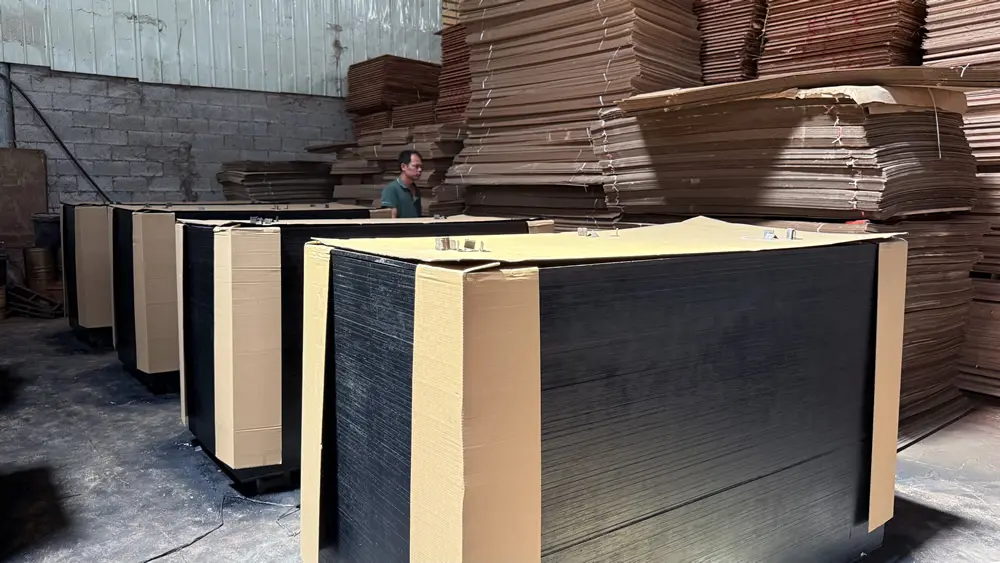
For importers purchasing container quantities, consistency between batches is important.
Thickness, flatness, core condition, surface quality, and film bonding should therefore be checked together rather than focusing only on glossy or matte appearance.
6. Are Glossy and Matte Film Faced Plywood Available in the Same Sizes?
In most cases, both surfaces can be supplied in common export specifications.
Some of our common specifications include:
Sizes
▪ 1220 × 2440 mm
▪ 1830 × 915 mm
Thicknesses
▪ 12 mm
▪ 15 mm
▪ 18 mm
▪ 20 mm
Other sizes and thicknesses can be discussed according to the destination market and project requirements.
For buyers, it is better to confirm the complete specification before comparing prices because even plywood with the same size and thickness can have different core, glue, film, and production requirements.
7. Which One Should You Choose: Glossy or Matte?
If you are an importer, distributor, or construction material buyer, we recommend starting with the actual application.
Glossy film faced plywood may be more suitable if:
▪ You need a smooth formwork surface
▪ Concrete surface appearance is important
▪ You need a commonly used formwork option
▪ Cost is an important consideration
Matte film faced plywood may be more suitable if:
▪ Your market prefers a matte finish
▪ You need a low-reflection surface
▪ You prefer a more uniform matte appearance
▪ Your customers specifically request matte formwork plywood
The final decision should be based on the project and market rather than assuming that one surface is always better than the other.
8. What Should You Tell Us Before Asking for a Quotation?
When buyers ask us for a film faced plywood quotation, complete specifications help us recommend the right product and calculate the price more accurately.
Please provide:
▪ Glossy or matte surface
▪ Panel size
▪ Thickness
▪ Required quantity
▪ Core requirements
▪ Glue requirements
▪ Intended application
▪ Destination port
▪ Packaging requirements
▪ Any special performance requirements
If you have used film faced plywood from another supplier before, you can also tell us what problems you experienced, such as surface issues, delamination, insufficient water resistance, thickness variation, or other problems during formwork use.
This helps us understand what you actually need instead of simply offering a standard specification.
Conclusion
The difference between glossy and matte film faced plywood is more than surface appearance.
Glossy film faced plywood can be produced using either a one-stage or two-stage process, depending on the required specification.
Matte film faced plywood requires two-stage production and additional sanding to achieve a flat and consistent matte surface. Because of these additional production requirements, matte plywood is normally more expensive.
But price should not be the only factor when choosing formwork plywood.
Core structure, glue, film bonding, thickness, flatness, construction conditions, and local market requirements should all be considered.
If you are sourcing film faced plywood from China, send us your required surface, size, thickness, quantity, application, and destination port. We can check the specification and recommend a suitable option based on your actual purchasing requirements. Get a quote for your required film faced plywood specification.
For immediate plywood inquiries, please contact us.